Contoso Investment Bank Berhad C-Suite Copilot Immersion
Group Finance, Risk & Outsourcing Workshop Enter the session password to continue.
🏦 Contoso IB
C-Suite Copilot Immersion
C-Suite Copilot Immersion
Contoso Investment Bank Berhad · Group Office · 2-Hour Executive Workshop
Welcome
This immersion experience puts you in the shoes of Priya, Group Chief Financial Officer of Contoso Investment Bank Berhad. The Board Risk Committee has been brought forward to Thursday 27 March 2026, a BNM follow-up letter on outsourcing oversight is sitting in your inbox with a 31 March response deadline, and the Group's strategic plan refresh is due to the Group MD next week. Over two hours you will work through four exercises that mirror the highest-value finance, risk, and operations decisions a Malaysian investment bank C-suite makes in any given week: peer benchmarking against Maybank IB, CIMB IB, Affin Hwang, RHB IB and Phillip Capital; segment-level variance analysis across the eight Contoso business segments; vendor outsourcing risk review against the BNM Outsourcing Policy; Board Risk Committee deck and Cowork delegation; and finally building your own Group Outsourcing & Finance Policy Advisor agent.
You will use Copilot in Excel, Word, and PowerPoint, the Researcher and Analyst agents in Microsoft 365 Copilot Chat, Cowork to delegate multiple board-pack tasks in parallel, and Agent Builder to publish a policy advisor your Group Finance, Risk and Procurement teams can use every day.
Learning Outcomes
Use the Researcher Agent to benchmark a Malaysian IB peer set and stress-test the Group's strategic risks with a multi-model view
Use Copilot in Excel to produce an 8-segment RAG variance table, Group CFO board commentary, and a Board Risk Committee dashboard from a single workbook
Use the Analyst Agent to run pivot analysis, flag persistent segment underperformance, and project year-end exposure against PBT guidance
Use Copilot in Word to review a managed-services vendor contract against the BNM Outsourcing Policy and surface every breach with RM exposure
Use Copilot in PowerPoint to generate a Board Risk Committee briefing deck from your findings
Use Cowork to delegate five committee-prep tasks in parallel: two Word documents, an email, a calendar invite, and a Teams message
Use Agent Builder to build a Group Outsourcing & Finance Policy Advisor agent grounded in the Group's policy manual
Apply the GCSE prompting framework (Goal · Context · Source · Expectation) to every task
Workshop Format
⏱️
2 Hours
🎯
4 Exercises
📄
4 Files Excel · Word · Word · Word
M365 Copilot No extra tools needed
🤖
Agent Builder Build your own agent
Your Story
You are Priya, Group CFO of Contoso Investment Bank Berhad
M365 Copilot · Contoso C-Suite
From Data to Decision
Persona
Priya
Group Chief Financial Officer Contoso Investment Bank Berhad
The Mission
Board Risk Committee was moved to Thursday. Three segments are above the 10% adverse-variance threshold, a critical vendor contract breaches the BNM Outsourcing Policy, and your Group Procurement team has no policy tool. Clear it all in one morning.
The Punchline
One morning. Ten tasks. From research to agent.
Ten tasks across one morning
Researcher + Word
01Researcher · Critique
Benchmark the peer set
Benchmark Contoso's governance posture against Maybank IB, CIMB IB, Affin Hwang, RHB IB and Phillip Capital. Critique enforces citation grounding on every claim.
02Model Council
Stress-test the strategy
Multiple frontier models independently assess the strategic risks for a Malaysian IB. The judge's cover letter shows where they agree, diverge, and what each adds.
03Word Copilot
Write the brief
Export the Researcher report to Word. Copilot drafts a Group MD briefing note with peer benchmarking, strategic risk register, and next steps.
Financial Analysis
04Excel Copilot
Variance & commentary
Full RAG variance table across all 8 segments + Group CFO board commentary in a single prompt. Segments breaching the 10% threshold are flagged for corrective action.
05Excel Copilot
Build the dashboard
Copilot builds a Board Risk Committee dashboard with KPI row, RAG bar chart, and monthly trend line, formatted for A4 landscape board pack.
06Analyst Agent
Interrogate the data
Drop in the segment P&L. Pivot tables, persistent-underperformance flags, and year-end PBT exposure projection. No setup needed.
Contract & Reporting
07Word Copilot
Find the breaches
Copilot reads the QuantumStream MSA and surfaces every HIGH and MEDIUM clause that breaches the BNM Outsourcing Policy with RM exposure quantified.
08PowerPoint Copilot
Build the deck
Copilot generates a 6-slide Board Risk Committee deck from the segment P&L and contract findings. No slide design needed.
09Cowork
Delegate five tasks
Five parallel tasks: two Word documents (BRC summary, BNM response memo), pre-committee email, calendar invite, and Teams message.
Build Your Agent
10Agent Builder
Build the future
Build a custom agent connected to your team's knowledge. Choose: Group Outsourcing & Finance Policy Advisor, BNM Compliance Q&A Agent, or Vendor Contract Intelligence Assistant.
THE VALUE: One Group CFO. One morning. Benchmark peers, analyse 8 segments, review a vendor contract, build a board deck, and deploy a custom Copilot agent, all without leaving Microsoft 365.
M365 Copilot Tools You Will Use
💬
Copilot Chat
Research, synthesis, and cross-file reasoning. Your AI research assistant.
16-section Group Outsourcing & Finance policy aligned to BNM/RH/PD 028-99, FSA 2013, CMSA 2007 and PDPA 2010
Before You Start
1
Save files to OneDrive
Open OneDrive, navigate to My Files → Documents, create a folder called KIBB Copilot Immersion and upload all 4 files. Wait for the upload to complete before starting.
2
Verify your Copilot licence
Open m365.cloud.microsoft and confirm the Copilot icon appears. If not, contact your IT admin.
3
Open Copilot Chat
Navigate to m365.cloud.microsoft/chat. Type / and look for the files by name to confirm Copilot can see them.
Tips Before You Start
Use specific, context-rich prompts: vague prompts return vague results
Always reference your file by name when prompting about it
If results are unexpected, rephrase and try again. Iteration is normal
Use the 📋 Copy buttons to copy prompts exactly as written
Compare outputs across the room and discuss the differences
Exercise 1 · Researcher
Tools: Researcher · Model Council · Copilot in Word
Objective
Use Researcher's Critique mode to benchmark Contoso's group governance and segment posture against the Malaysian investment banking peer set, then switch to Model Council for a multi-model assessment of the strategic risks facing a domestic IB over the next 24 months, and finally use Copilot in Word to turn the research into a Group MD briefing note.
Step 1 · Open the Researcher Agent
1
Go to Copilot Chat and click Researcher in the agents panel on the right.
2
You will use two modes across Tasks 1 and 2:
🔍 Critique (Auto)
The default mode. One model researches and drafts; a second independently reviews source reliability and evidence grounding before the final report is delivered. Every key claim is anchored to a citable source.
⚖️ Model Council
Multiple models each run your prompt independently and produce full standalone reports. A judge model then writes a cover letter highlighting where models agree, diverge, and what unique insight each brings.
Task 1 · Critique: Malaysian IB Peer Benchmarking
Keep the model selector on Auto (this is Critique). Use the prompt below:
I am the Group Chief Financial Officer of Contoso Investment Bank Berhad, a Bursa-listed Malaysian investment bank with approximately RM 1 billion in annual revenue across eight business segments, including Equities and Stockbroking, Investment Banking, Asset and Wealth Management, Listed Derivatives, Islamic Banking, Money Lending and Financing, Treasury, and Group Support. The Group MD has asked me to benchmark our group posture before next week's strategic plan refresh. I need you to research how comparable Malaysian investment banks, specifically Maybank Investment Bank, CIMB Investment Bank, Affin Hwang Investment Bank, RHB Investment Bank, and Phillip Capital Malaysia, are positioned across the following dimensions: stockbroking and equities market share including disclosed retail versus institutional mix, investment banking deal origination footprint covering ECM, DCM, and M&A, assets under management in the asset and wealth management segment with retail versus institutional split, listed derivatives and futures broking presence on Bursa Malaysia Derivatives, Islamic banking and capital markets product breadth, and disclosed cost-to-income ratio and return on equity for the most recent reported financial year. Present your findings as a comparison table with each peer institution as a column and each dimension as a row. In a separate paragraph below the table, highlight the two or three areas where Contoso's positioning is likely to differ most significantly from peers, and flag any segments where peer disclosure suggests we may be sub-scale and where consolidation, partnership, or strategic exit should be on the agenda for the Group Board.
Check the citations in the report. Critique enforces strict evidence grounding, requiring every key claim to be anchored to a reliable, citable source before the final output is produced.
Task 2 · Model Council: Strategic Risk Assessment
Click the model picker in Researcher and switch to Model Council. Each model will run your prompt independently and produce its own full report. Use the prompt below:
I am the Group Chief Financial Officer of Contoso Investment Bank Berhad. I need a strategic risk assessment of the top financial, regulatory, and operational risks facing Malaysian investment banks over the next 24 months. Consider the following dimensions: BNM regulatory pressure on outsourcing and material technology risk, including the BNM Outsourcing Policy BNM/RH/PD 028-99, BNM Risk Management in Technology RMiT, and emerging operational resilience expectations; Bursa Malaysia listing requirement evolution on sustainability disclosure and the Group's readiness for the National Sustainability Reporting Framework aligned to ISSB IFRS S1 and S2; revenue concentration risk in stockbroking as retail trading volumes normalise post-pandemic and as zero-commission digital brokers continue to compress margins on cash equities; investment banking deal pipeline risk in a softer ECM and M&A environment with peers chasing the same transactions; cyber and third-party concentration risk where critical functions including trading platform hosting, market data, and post-trade settlement are dependent on a small number of providers; and talent and retention risk for licensed dealer's representatives, senior bankers, and quantitative trading staff in a market where regional players and global digital asset platforms are aggressively recruiting. For each risk, assess the likelihood and potential financial impact in RM, describe how leading regional and Malaysian peers are mitigating it, and suggest one concrete governance action the Contoso Group Board should prioritise in the next six months. Present as a structured risk register with a one-paragraph executive summary at the top.
Read the cover letter, written by a dedicated judge model that compares both reports and highlights where they agree, where they diverge, and the unique insight each model brings. That is where the real value of Model Council shows.
Task 3 · Word: Group MD Briefing Note
First, get your Task 1 Critique research into Word:
Critique output: In your Researcher report, click the Export button → Convert to Word. The document saves automatically to your OneDrive. Open it from OneDrive.
Model Council output: Choose the report you prefer. Select all → Copy. Open a blank Word document, paste, and save to your OneDrive.
Open the Word document. In the Home ribbon → Copilot pane, use the prompt below to draft the Group MD briefing note:
Based on the research content in this document, draft a one-page Group MD briefing note for the Contoso Investment Bank Berhad strategic plan refresh discussion. Structure it as follows: open with a one-paragraph executive summary stating the overall positioning of Contoso relative to the Malaysian investment banking peer set and the headline strategic risk we face in the next 12 to 24 months. Follow with a peer benchmarking summary table showing where Contoso stands on each of the key positioning dimensions compared to the peer institutions, using a simple Above Peer, In Line, or Below Peer rating for each dimension. Then write a section covering the top three strategic risks that require Board-level decisions this financial year, each with a plain-English explanation of the risk and a specific recommended action with a proposed owner at Group ExCo level and a clear timeline. Close with a next steps paragraph recommending the two or three structural decisions the Group MD should bring to the Group Board before the next strategic plan tabling. Write all narrative in formal business English suitable for a Board-level audience. Use square bracket placeholders for any data point not confirmed in the research. Target length is 350 to 400 words.
Exercise 2 · Financial Analysis
Tools: Copilot in Excel · Analyst Agent
Objective
Open the Group segment P&L workbook in Excel. Use Copilot in Excel to surface segments that have breached the 10% adverse-variance threshold, draft Group CFO board commentary, and build an executive Board Risk Committee dashboard, then hand the same data to the Analyst Agent for deeper AI-driven analysis ahead of Thursday's committee.
Task 1 · Variance Analysis & Group CFO Commentary
Open 01_KIBB_SegmentPnL.xlsx in Excel. Navigate to the Monthly_PnL sheet and open Copilot from the Home ribbon → Copilot.
I am the Group Chief Financial Officer of Contoso Investment Bank Berhad preparing the FY2025 year-end Board Risk Committee pack, which the Group MD needs ahead of Thursday 27 March 2026. Using the Monthly_PnL sheet in this workbook, I need two outputs placed together in a new sheet called Board Summary. First, produce a Board Risk Committee variance summary table covering every business segment, showing actual revenue and operating cost year-to-date, budget year-to-date, the RM variance, and the variance as a percentage, with a RAG status column where Red means over 10% adverse, Amber means 5 to 10% adverse, and Green means within 5% of budget. Flag any segment where the variance has breached the 10% threshold that triggers a mandatory corrective action plan and a written explanation to the Group Board under our internal policy, and for those segments add a one-sentence explanation of the likely commercial driver based on the data visible in the sheet. Second, immediately below the table in the same Board Summary sheet, draft the Group CFO narrative commentary for the Board Risk Committee pack. This should open by stating the Group's overall full-year PBT position in both RM and percentage terms relative to budget, discuss the two segments with the most significant adverse variances by name and explain what is driving each shortfall, briefly acknowledge the best-performing segment to give a balanced view, explicitly state which segments have triggered the corrective action threshold, and close with a clear statement of the management actions proposed and the timeline for resolution before the next Board cycle. Write the commentary in formal continuous prose, no bullet points, 200 to 220 words, suitable for a Board Risk Committee pack and consistent with Bursa-listed disclosure standards.
Task 2 · Board Risk Committee Dashboard
Stay in 01_KIBB_SegmentPnL.xlsx with Copilot in Excel open. Ask Copilot to build an executive dashboard sheet with no pivot table or chart setup needed.
💡 Note: Copilot in Excel will create the new sheet, build the charts, and add the summary table. Print layout formatting (A4 landscape) may need a quick manual tidy. Use Page Layout → Fit to Page if needed.
I am preparing a Board Risk Committee pack for Contoso Investment Bank Berhad and I need a visual executive dashboard built directly in this workbook so it can be printed and included as a single-page insert for the committee. Using the data in the Monthly_PnL sheet, create a new sheet called Dashboard and build the following elements on it. At the top of the page create a KPI summary row with three clearly labelled headline boxes showing total Group revenue year-to-date in RM, total Group budget year-to-date in RM, and the overall Group PBT variance expressed as both an RM figure and a percentage with a RAG indicator so the committee sees the Group position in seconds. Below the KPI row create a horizontal bar chart ranking every business segment by their year-to-date adverse variance from worst to best, with RAG colour coding applied directly to the bars: Red for over 10% adverse, Amber for 5 to 10%, Green for within budget, so the committee can immediately see which segments need attention without reading a table. Add a second chart showing the monthly trend of total Group revenue versus total budget for all 12 months as a dual-line chart, so the committee can see whether the gap is widening or narrowing over time and assess whether the variance is structural or seasonal. Finally add a compact summary table below the charts listing only the Red-flagged segments with columns for segment name, YTD variance in RM, variance percentage, and a status cell reading Corrective Action Required. Format the entire dashboard to fit and print cleanly on a single A4 landscape page so it can be inserted directly into the Board Risk Committee pack without resizing.
Task 3 · Analyst Agent
The Analyst Agent is a built-in agent in Copilot Chat that writes and runs its own code to analyse data, with no Excel skills or formula setup needed. Open Copilot Chat, select Analyst from the agents panel, and upload 01_KIBB_SegmentPnL.xlsx.
I am the Group Chief Financial Officer of Contoso Investment Bank Berhad and I am uploading the FY2025 segment P&L workbook to prepare for Thursday's Board Risk Committee. I need the Analyst Agent to run a full quantitative analysis on the Monthly_PnL sheet and produce six specific outputs. First, build a complete pivot table showing actual operating cost versus budget for every business segment across all 12 months of FY2025 with a variance column, a variance percentage column, and RAG conditional formatting applied automatically so Red cells indicate over 10% adverse variance, Amber indicates 5 to 10%, and Green indicates within budget. Second, generate a horizontal bar chart ranking every segment by total full-year adverse cost variance from worst to best, with RAG colour coding on the bars, so the committee can see the full picture at a glance. Third, produce a dual-line chart showing total Group operating cost actual versus budget for each month across the full year, so the committee can see whether the variance gap is widening, narrowing, or seasonal. Fourth, produce a stacked bar chart breaking down monthly cost contribution by segment for the year so the Board can see which segments are driving Group cost growth or decline over time. Fifth, analyse the monthly trend data for every segment and identify those that have exceeded budget for three or more consecutive months, because a persistent multi-month pattern indicates a structural cost problem rather than a one-off timing issue, and present these in a separate flagged table with the segment name, number of consecutive months of overspend, and total cumulative overspend amount. Sixth, also pull in the Segment_Revenue sheet to calculate full-year Group PBT (revenue minus operating cost) by segment and the Group total, and present a segment-by-segment PBT table with a grand total at the bottom for the Group MD briefing.
Exercise 3 · Contract & Reporting
Tools: Word, PowerPoint, Cowork
Objective
Use Copilot in Word to find clauses in the QuantumStream managed-services agreement that breach the BNM Outsourcing Policy and the Group Outsourcing & Finance policy. Use PowerPoint Copilot to build the Board Risk Committee deck. Use Cowork to delegate five parallel follow-up tasks before the committee.
Task 1 · Word: Vendor Contract Review
Open 02_KIBB_VendorContract.docx in Word. Open Copilot from the Home ribbon → Copilot pane.
I am the Group Chief Financial Officer of Contoso Investment Bank Berhad and I am preparing for the Board Risk Committee on Thursday 27 March 2026. This document is the managed-services agreement signed with QuantumStream Technologies Sdn Bhd, our outsourced trading platform and post-trade processing provider, at a contract value of RM 240,000 per month over 36 months and a total contract value of approximately RM 8.64 million. The board has asked me to confirm that the contract is fully compliant with our Group Outsourcing and Finance policy and with BNM Outsourcing Policy BNM/RH/PD 028-99 before the next renewal cycle. Read this contract carefully end to end and identify every clause that creates a HIGH or MEDIUM risk for Contoso or that breaches our internal Group policy. For each issue identified, present the finding in a structured table with the following columns: contract clause reference and section number, risk rating of HIGH or MEDIUM, a plain English explanation of the issue and why it matters from a regulatory and commercial perspective, the corresponding Contoso Group Outsourcing and Finance policy reference that has been breached, the estimated annual or contract-life RM exposure, and a specific recommended remediation action that should be tabled at the Board Risk Committee. Pay particular attention to clauses dealing with pricing escalation and variation rights, contract term and renewal mechanics, data ownership and intellectual property in derived data sets, cross-border data hosting and offshoring of customer information including the requirement for prior BNM written consent, audit rights for Contoso Internal Audit and BNM examination access, service availability and recovery time objectives, and limitation of liability and exclusions. Do not omit any HIGH or MEDIUM risk you find, and present the findings in descending order of severity so the most material breaches appear first.
After Copilot generates the table, you should see the following risk findings:
Clause
Risk
Issue
Policy reference breached
4.2 (Annual Adjustment)
HIGH
Unilateral 7% annual escalation by vendor
§4.3 caps annual increase at 3% with prior written approval
5.1 (Auto-Renewal)
HIGH
45-day non-renewal notice insufficient for orderly transition of a critical IT outsourcing
§6.2 requires minimum 90 days for material outsourcing
6.2 (Derived Data)
HIGH
Vendor claims ownership of derived analytics and ML training data
§7.1 all bank and customer data including derivatives must remain bank IP
6.3 (Data Hosting)
HIGH
Cross-border hosting at vendor discretion with only 30 days notice
§7.2/7.3/7.4 requires prior BNM written consent under BNM/RH/PD 028-99
7.1 (Audit)
MEDIUM
Audit limited to once per year, vendor charges costs, no BNM examination access
§8 requires unlimited regulator and Internal Audit access at vendor cost
8.1/8.2 (SLA & RTO)
HIGH
99.5% availability and 24-hour RTO inadequate for trading platform
§9.1 requires 99.9%; §9.2 requires 2-hour RTO for critical systems
9.1/9.2 (Liability)
HIGH
Liability cap of 6 months fees (~RM 1.44m), excludes data loss and reputational harm
§10.1 minimum 12 months; §10.2 uncapped carve-outs for data loss, fraud, regulatory penalties
Task 2 · PowerPoint: Build the Board Risk Committee Deck
Open a blank PowerPoint presentation. Open Copilot from the Home ribbon → Copilot pane.
💡 Tip: Make sure both 02_KIBB_VendorContract.docx and 01_KIBB_SegmentPnL.xlsx are saved to your OneDrive so Copilot can reference them by name.
Build a Board Risk Committee deck for Contoso Investment Bank Berhad referencing 02_KIBB_VendorContract.docx and 01_KIBB_SegmentPnL.xlsx. Format as a professional financial-services board pack, Contoso-branded, navy and white, six slides total. Slide 1 is the cover slide titled "FY2025 Year-End Board Risk Committee — Group Risk & Outsourcing Review", subtitle "Prepared by Group CFO, Priya", dated Thursday 27 March 2026. Slide 2 is the Executive Summary listing three headline messages: Group PBT performance versus budget with overall RAG status; identified BNM Outsourcing Policy breaches in the QuantumStream Technologies managed-services agreement; and recommended Board decisions. Slide 3 is the Segment Variance Snapshot showing the four segments with the largest adverse variance to budget with RM and percentage figures and RAG status. Slide 4 is the Vendor Contract Risk Register summarising every HIGH and MEDIUM finding from the QuantumStream contract review with one-line descriptions and RM exposure. Slide 5 is the Recommended Actions slide with five concrete decisions for the Board: corrective action plans for breached segments, immediate written notice to QuantumStream on the seven non-compliant clauses, regularisation plan to BNM under the Outsourcing Policy notification framework, refresh of the Group Outsourcing and Finance policy where gaps are identified, and approval of the FY2026 outsourcing oversight budget. Slide 6 is Next Steps with owners, timelines, and the date of the next checkpoint. Keep all bullets to a maximum of two lines, use clean board-pack typography, and avoid stock imagery.
Task 3 · Cowork: Five Parallel Tasks
Cowork lets you delegate multiple tasks to Copilot in parallel. Open Copilot Chat, click Cowork from the agent panel, and paste the prompt below.
I am the Group Chief Financial Officer of Contoso Investment Bank Berhad preparing for the Board Risk Committee on Thursday 27 March 2026. I need you to handle five tasks in parallel. Task 1: create a Word document titled "FY2025 Year-End Board Risk Committee — Pre-read Summary" containing a 250-word executive briefing covering segment variance highlights and the QuantumStream Technologies vendor contract findings, suitable for the Group MD and the Chairman to read in five minutes ahead of the meeting, and save it to my OneDrive. Task 2: create a second Word document titled "BNM Outsourcing Policy — Response Memo" containing a draft response to BNM regarding the QuantumStream Technologies managed-services agreement, written in formal regulatory correspondence style, acknowledging the identified non-compliances against BNM/RH/PD 028-99, outlining the remediation plan and timeline, and stating Contoso's commitment to ongoing compliance, and save it to my OneDrive. Task 3: draft an Outlook email to the Board Risk Committee members (use placeholders [BRC Chair], [Group MD], [Chief Risk Officer]) confirming the meeting on Thursday 27 March 2026 from 10:00 to 12:00 in the Boardroom, attaching the pre-read summary, and listing the agenda: FY2025 segment performance review, vendor outsourcing risk update, BNM Outsourcing Policy compliance, and recommended Group Board actions. Task 4: create an Outlook calendar invite for the Board Risk Committee meeting on Thursday 27 March 2026 from 10:00 to 12:00 with all committee members, the Boardroom location, and the agenda in the body. Task 5: draft a short Teams message to my Finance and Risk leadership channel notifying them that the FY2025 year-end board pack and BNM response memo are with the Group MD for sign-off and that the Board Risk Committee is confirmed for Thursday morning. Run all five tasks in parallel and report back when each is complete.
Exercise 4 · Build Your Custom Agent
Tool: Microsoft 365 Agent Builder
Objective
Build a custom Copilot agent that wraps your team's institutional policy knowledge in a re-usable, governed assistant. Today's example is the Group Outsourcing & Finance Policy Advisor, an agent that any Contoso Procurement, Finance, or Risk Manager can ask about the Group Outsourcing & Finance policy and receive a precise, traceable answer grounded in the policy document and its BNM, FSA, CMSA, and PDPA references.
The Business Case
Your Group Procurement team currently consults the Group Outsourcing & Finance policy manually for every material vendor agreement, every cross-border data transfer, every renewal, and every variation. The policy is 16 sections long, references multiple BNM, FSA, CMSA, and PDPA provisions, and is updated periodically. A custom Copilot agent grounded in the policy document gives every Procurement Manager an instant, accurate, citation-backed second opinion before they sign off on a vendor request.
In the right-hand pane, find the Agents section and click Create agent, or open the Agent Builder directly from the agents panel.
3
You can create your agent by chatting with the builder using natural language, or by filling in the structured fields manually. Today we will use the natural-language route.
Task 2 · Describe Your Agent
In the Agent Builder chat, paste the prompt below to describe the agent you want:
I want to create a custom Copilot agent called "Group Outsourcing & Finance Policy Advisor" for Contoso Investment Bank Berhad. The agent's purpose is to help our Group Procurement, Finance, and Risk colleagues quickly check whether a proposed vendor engagement, contract clause, or change is compliant with the Contoso Group Outsourcing and Finance policy and the underlying regulatory requirements from Bank Negara Malaysia, the Financial Services Act 2013, the Capital Markets and Services Act 2007 and the Personal Data Protection Act 2010. The agent should answer questions in clear, plain English, always cite the specific policy section number and any external regulation referenced, and where the proposal is non-compliant or borderline, suggest the specific remediation step required, including any prior written approval needed from BNM under the Outsourcing Policy notification framework. The tone should be that of a senior internal risk advisor: precise, helpful, and action-oriented. The agent must always recommend the user consult the Chief Risk Officer or Group Compliance for high-risk or material outsourcing engagements before any final decision is taken.
Task 3 · Add the Policy as Knowledge
1
In the Agent Builder, scroll to the Knowledge section.
2
Click Add knowledge and select Files.
3
Upload 04_KIBB_GroupOutsourcingFinancePolicy.docx from your OneDrive.
4
Confirm the file shows under Knowledge with a green tick.
Task 4 · Add Starter Prompts
In the Agent Builder, scroll to the Starter prompts section. Add the following four starter prompts so users immediately know how to engage the agent:
Vendor pre-engagement check. "I am about to engage [VENDOR] for [SERVICE] at an estimated annual contract value of RM [AMOUNT]. What does our Group Outsourcing & Finance policy require me to do before signing?"
Cross-border data hosting. "A vendor wants to host Contoso customer data in [COUNTRY]. What are our policy and BNM requirements?"
Material outsourcing definition. "How do I determine whether an outsourcing arrangement is classified as material outsourcing under our policy and BNM/RH/PD 028-99?"
Contract renewal triggers. "What are the policy requirements when a material outsourcing contract is approaching renewal?"
Task 5 · Test Your Agent
Use the Test pane on the right side of the Agent Builder. Try the prompt below:
I am the Group CFO. Our trading platform vendor wants to vary our existing managed-services agreement so that our customer trading data can be hosted in their Singapore data centre instead of Kuala Lumpur, with a 30-day notice period for any future moves of that data to other regions. The vendor argues this gives them better resilience and lower latency. What do our Group Outsourcing & Finance policy and the underlying BNM Outsourcing Policy require me to do before I can approve this change, who within Contoso needs to be involved, and what specific written approvals or notifications are required from Bank Negara Malaysia? Please cite the relevant policy section numbers in your answer.
A correctly grounded agent will cite §7.2, §7.3, and §7.4 of the policy, reference BNM/RH/PD 028-99, and explicitly state that prior BNM written consent is required before any cross-border hosting of customer data.
Task 6 · Save and Share
1
Click Create at the top of the Agent Builder to save your agent.
2
Once created, click Share.
3
Add the email addresses of your Group Procurement, Finance, and Risk colleagues. They can now access the agent directly from their Copilot Chat.
Use Cases at Contoso
Where M365 Copilot can deliver immediate value across Group Finance, Procurement, and Risk
The Pain: Group Finance team spends two to three working days each month preparing the segment variance pack, drafting the Group CFO commentary, and circulating it for review across eight business segments before it reaches the Group MD and the Group Board.
The Copilot Solution: Excel Copilot reads the segment P&L file, builds the variance table with RAG status, and drafts the Group CFO commentary in formal Bursa-disclosure language, in minutes. Group Finance moves from preparing numbers to challenging them.
2. Capital, Liquidity & Stress Testing Narrative
The Pain: Quarterly capital and liquidity reporting to BNM and the Group Board requires Treasury and Finance to coordinate inputs from multiple systems and write a consistent narrative covering capital adequacy ratios, liquidity coverage, and stress testing outcomes.
The Copilot Solution: Copilot Chat synthesises Treasury, Risk, and Finance data into a single Group narrative for the BNM submission and the Board pack, with consistent terminology and tone across cycles.
The Pain: The Investment Banking head reviews the deal pipeline weekly across ECM, DCM, and M&A but consolidating updates from each deal team takes hours of email and Teams scraping before any insight can be drawn for the Group MD.
The Copilot Solution: Copilot summarises the IB pipeline from emails, Teams threads, and uploaded pipeline trackers, flags slipping mandates, calculates conversion rates by deal type, and drafts the Group MD update in minutes.
4. ESG & Bursa Sustainability Disclosure
The Pain: Bursa's National Sustainability Reporting Framework, aligned to ISSB IFRS S1 and S2, increases the scope and depth of mandatory disclosures every year. Drafting Group sustainability statements consistent with prior-year disclosures and peer practice is a heavy lift for the Sustainability and Investor Relations teams.
The Copilot Solution: Copilot ingests prior-year Annual Report sustainability statements, peer disclosures, and current-year data, and drafts the Group sustainability statement in Bursa-aligned format with consistent terminology.
5. Year-End External Audit Readiness
The Pain: The external audit cycle generates hundreds of audit queries across Group Finance, Treasury, and the segments. Drafting accurate, consistent management responses with supporting working papers consumes weeks of senior Finance time each year-end.
The Copilot Solution: Copilot drafts management responses to audit queries from the relevant working papers, prior-year responses, and accounting policies, with the Finance Manager reviewing and signing off, dramatically compressing the year-end timetable.
Group Procurement & Vendor Risk Use Cases
1. Vendor Outsourcing Compliance Review
The Pain: Every material vendor agreement, renewal, and variation must be checked manually against the Group Outsourcing & Finance policy and BNM/RH/PD 028-99 before sign-off. Procurement Managers default to escalating everything to Compliance, slowing the business.
The Copilot Solution: The Group Outsourcing & Finance Policy Advisor agent (built in Exercise 4) gives every Procurement Manager an instant, citation-backed second opinion on any vendor proposal, with Compliance and the CRO reserved for genuinely material decisions.
2. Material Outsourcing Onboarding (BNM-aware)
The Pain: Onboarding a material outsourcing partner involves a multi-stage due-diligence pack, a board paper, a BNM notification, and an internal risk register entry. Coordinating this across Procurement, Risk, Compliance, and Legal takes weeks of effort and many meetings.
The Copilot Solution: Copilot drafts the due-diligence questionnaire, the board paper sections, the BNM notification cover letter, and the risk register entry from the same single set of vendor inputs, in a consistent and re-usable template.
3. Cross-Border Data Transfer Assessment (PDPA + BNM)
The Pain: Any vendor proposal that touches customer data hosted offshore must be assessed against PDPA 2010, BNM Outsourcing Policy, and BNM RMiT. The assessment cuts across Legal, Compliance, Risk, and Data Protection, and the documentation trail is rarely consistent.
The Copilot Solution: Copilot reviews the proposed arrangement against the policy and regulations, drafts the cross-border transfer assessment, and produces a consistent file note for the Data Protection Officer and the CRO to approve.
4. Cyber and Operational Incident Briefing
The Pain: When a third-party or internal cyber or operational incident occurs, the Group MD, Group CRO, and the Board need a clear, factual briefing within hours. Pulling together the timeline, impact, and response plan from incident logs and Teams chats under time pressure is painful.
The Copilot Solution: Copilot ingests the incident logs, Teams chats, and stakeholder updates, and drafts the Board-ready incident briefing with a clear timeline, impact, root cause hypothesis, and response plan, ready for review by the Group CRO.
5. Tender Evaluation for Trading Platform Refresh
The Pain: Strategic platform tenders generate thousands of pages of vendor proposals across multiple bidders. Comparing them on a like-for-like basis, scoring them against requirements, and producing the evaluation report is a multi-week effort for the tender committee.
The Copilot Solution: Copilot reads each vendor proposal, extracts responses against the published requirements matrix, scores them on a consistent scale, surfaces any non-responsive items, and drafts the evaluation report, with the tender committee reviewing and finalising rather than starting from scratch.
Prompt Engineering Tips
How to get the most out of M365 Copilot
The GCSE Framework
Effective Copilot prompts contain four elements:
Element
What it means
Example
G — Goal
What outcome do you want?
"Draft a Board Risk Committee paper"
C — Context
What is the situation, who is the audience?
"For the Contoso Group Board, addressing BNM follow-up"
S — Source
What documents or data should Copilot use?
"Based on /02_KIBB_VendorContract.docx"
E — Expectations
What should the output look like?
"Formal English, 350 words, structured table"
Best Practices
Be specific. "Summarise this contract" is too vague. "Identify HIGH and MEDIUM risk clauses against BNM/RH/PD 028-99 and our Group Outsourcing & Finance policy with RM exposure quantified" is great.
Reference files by name. Use the format /filename.ext in Copilot Chat. In Word, Excel, and PowerPoint, Copilot already sees the open file.
Specify the format. Table, bullet list, formal prose, board pack tone, regulatory correspondence — say so explicitly.
Iterate. The first response is rarely the final one. Refine: "make it more formal", "shorten to 200 words", "add a column for RM exposure".
Use the right tool for the job. Copilot Chat for cross-file synthesis, in-app Copilot for editing in context, Researcher for cited research, Analyst for data analysis, Cowork for parallel delegation, Agent Builder for re-usable knowledge agents.
COPY-PASTE READY · 15 USE CASES
Cowork Runbook
15 end-to-end Cowork prompts for the investment-bank functional teams — Risk & Credit, Compliance, Finance, Strategy, IT, HR, Procurement and Sales & Marketing. Each one orchestrates a multi-step workflow from your uploaded files to a finished deliverable. Filter by department, then open a card to copy the prompt.
Heads up: Cowork is a Microsoft 365 Copilot Frontier-program experience. If your tenant is not yet enrolled, the agent panel will not show the Cowork tile. Researcher Critique & Council, Analyst, Word/Excel/PowerPoint Copilot, and Agent Builder all work on the standard M365 Copilot license.
Department
UC 01
Credit Underwriting Pack
Risk & CreditAdvanced
Borrower's annual report and audited financials become a 9-section credit underwriting memo aligned to BNM/MAS underwriting standards, with cited section references throughout.
You are acting as a senior credit risk officer preparing an underwriting recommendation. I have uploaded [BORROWER]'s annual report, audited financials and latest management accounts. Produce a structured credit underwriting memo of no more than 12 pages with the following sections:
A. Executive Summary (Credit View - max 1 page)
B. Financial Performance Analysis - revenue growth, EBITDA margin trend, one-off items, last 3 years
C. Balance Sheet & Liquidity Assessment - current ratio, quick ratio, working capital trend
D. Cash Flow Adequacy Review - operating cash flow, free cash flow, debt service coverage
E. Leverage & Coverage Metrics Table (multi-year): Debt/EBITDA, EBITDA/Interest, Net Debt/Equity
F. Accounting & Disclosure Risk Commentary on auditor's notes, going concern, related-party transactions
G. Debt Servicing Capacity Assessment under base, stress and downside scenarios
H. Key Credit Risks & Red Flags - potential early warning indicators, structural weaknesses
I. Required Follow-Up Items for Credit Approval - missing information needed for underwriting and questions to put to management
Cite statement sections and note numbers when highlighting findings. Do not fabricate any financial metric not derivable from the provided documents. Maintain professional tone suitable for an internal credit committee. Save as 'Underwriting_Memo_[BORROWER]_[DATE].docx' to /Credit/Underwriting/[BORROWER]/.
WHAT TO WATCH
Section/note citations anchor every finding. The 'do not fabricate' guard prevents hallucinated ratios. Auto-filing keeps the credit folder tidy.
HONEST FRAMING
Cowork does the read-and-summarise heavy lift. The credit committee still owns the call. Use the memo as a starting draft, not a substitute for analyst judgement.
UC 02
Investment Council of Agents
Risk & CreditAdvanced
A multi-role analyst panel (Fundamental, Macro, Risk, Stress, Compliance) debates the investment merits of a target. Produces an audit-ready interim report with explicit dissent captured.
PromptConvene the council and produce the IC interim report
You are acting as a council of agents to help an investment committee assess investment merits for [TARGET]. Convene a panel covering five roles and produce an audit-ready interim report. For each of the following roles, perform deep analysis, produce dissent where appropriate, and capture evidence with traceability.
Roles:
1. Fundamental Analyst. Perform deep fundamental analysis (financials, business model, unit economics, moat, management quality, comparables). Internal outputs: cite ranges, sensitivity table, quality of earnings.
2. Macro Strategist. Test macro regime (growth/inflation, policy path, rates/FX, liquidity conditions, cross-asset correlation). Internal outputs: macro sensitivity table, regime risks, hedging implications, correlation surprises.
3. Risk Officer. Provide independent risk view across market risk (VaR/ES), credit risk, liquidity risk, concentration, tail risk. Internal outputs: risk register, key limits breached, proposed risk mitigations, risk-adjusted return commentary.
4. Stress Tester. Run structured scenarios (base/bull/bear + bespoke shocks) and identify non-linear losses and second-order effects. Internal outputs: stress narrative, kill-switch thresholds, scenario tree, early warning indicators.
5. Compliance & Policy Agent. Check the investment for permissibility (mandate constraints, restricted lists, suitability, prudential governance, conduct and disclosure obligations). Internal outputs: 'Permitted / Not permitted / Permitted with conditions', required disclosures, required approvals.
Finally analyse all five views together for recommendations, evidence, assumptions, and dissenting views, with traceability. Capture all interim deliberations. Save the merged interim report as 'IC_Interim_[TARGET]_[DATE].docx' to /Investments/Pipeline/[TARGET]/. Length cap 25 pages.
WHAT TO WATCH
Each role produces dissent explicitly; the merged report keeps disagreements visible (do not average them away). The traceability requirement forces evidence-by-evidence sourcing.
HONEST FRAMING
This is a structured prompt for one model role-playing five voices, not five independent agents. If you want true multi-model perspectives, use Researcher Council mode in parallel for the same target.
UC 03
UBO Diagram & KYC PDF
Legal & ComplianceIntermediate
Recursively unwind a corporate shareholder tree to identify the ultimate beneficial owners and produce a one-page KYC diagram, exported to PDF for the customer file.
Create an Ultimate Beneficial Ownership (UBO) diagram for [ENTITY_NAME]. Recursively identify the UBO of each identified shareholder until you reach individual shareholders. Where a corporate shareholder owns >= 10% of the entity, treat as material and include in the diagram. If you cannot resolve a branch to an individual within the documents provided, mark it 'UBO not established - investigate'. Use a hierarchical tree layout. Annotate each box with: legal entity name, country of incorporation, % ownership, and source (document name + page number). Produce as a PowerPoint slide and export to PDF for the KYC file. Save to /Compliance/KYC/[ENTITY_NAME]/UBO_[DATE].pdf.
WHAT TO WATCH
The 'UBO not established - investigate' marker surfaces gaps rather than hiding them. The page-number citations let your KYC officer audit each branch.
HONEST FRAMING
Cowork reads the documents you provide. It will not query Companies Commission registries or external corporate databases - bring those documents into the conversation first.
UC 04
Bank Statement Extraction
OperationsIntermediate
Mixed-format bank statements (PDF, image, scanned) become a clean Excel workbook split by month, sorted chronologically, with multi-line transactions captured intact.
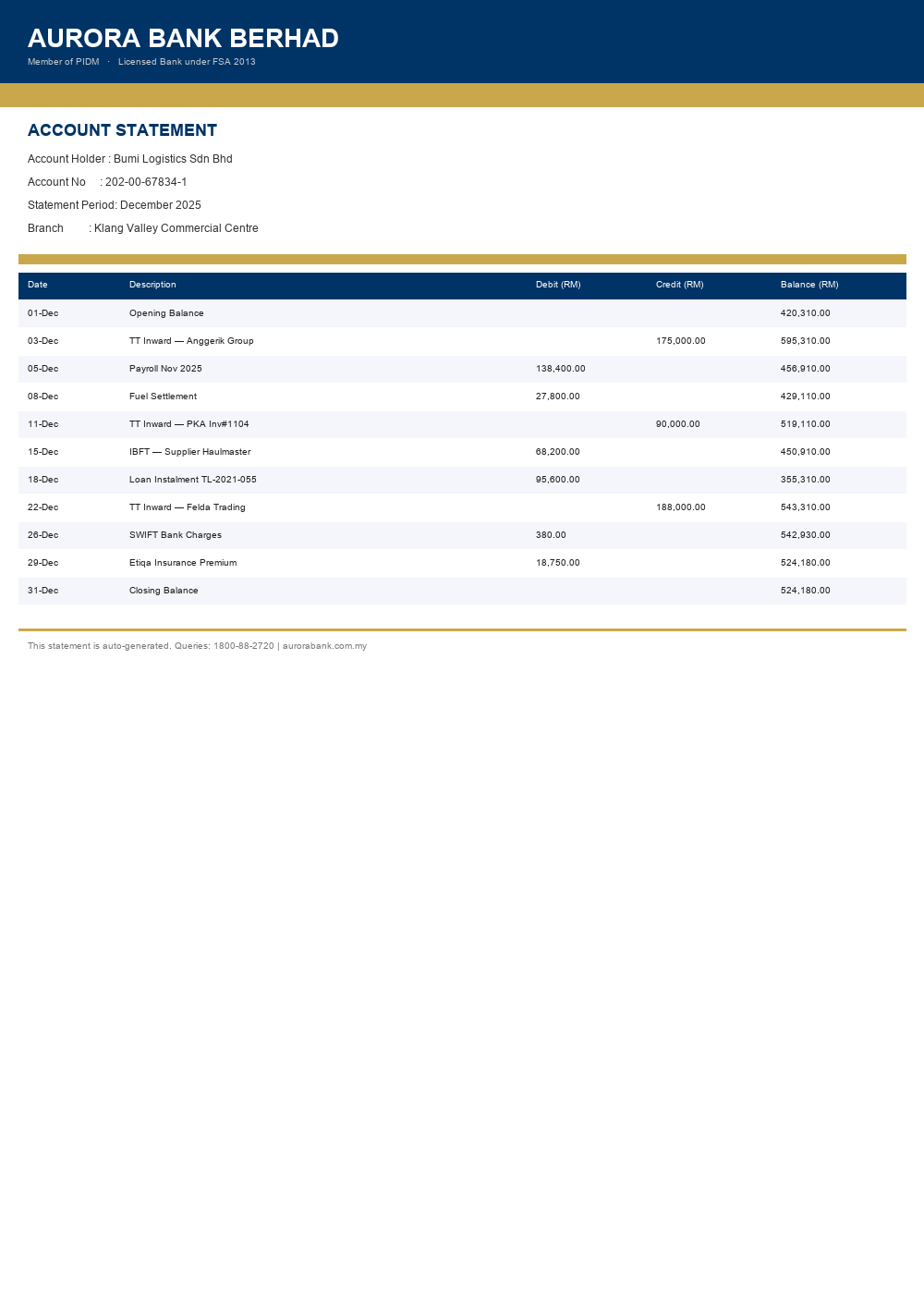
Extract the contents from the bank statements I have uploaded into a single Excel workbook with the following columns: Page No, Bank, Transaction Date, Description, Debit, Credit, Running Balance, Currency.
Standardise the date format on yyyy-MMM-dd.
Capture multi-line transaction details - concatenate continuation lines into a single Description cell.
Ignore any text that is not part of a transaction (logos, marketing, addresses, footer disclosures).
Don't perform any translation.
Split the transactions by month into separate worksheets named 'YYYY-MM'. For each worksheet, sort transactions chronologically ascending.
Flag any row where amount or date confidence is low by appending '** LOW CONFIDENCE' to the Description so a human can review.
Save as 'Statements_Consolidated_[CUSTOMER]_[DATE].xlsx' to /Operations/Reconciliation/[CUSTOMER]/.
WHAT TO WATCH
Three different formats land in the same standardised schema. Multi-line descriptions stay intact; bank-side header noise (logos, marketing, addresses) is filtered out. Date normalisation to yyyy-MMM-dd makes downstream reconciliation trivial. One worksheet per month, sorted ascending - reconciliation-ready, not just an extract.
HONEST FRAMING
OCR quality on scanned or low-resolution images can produce edge-case errors on amounts and dates. The LOW CONFIDENCE flag asks for human review rather than silently committing them. Bank-specific layouts evolve; new statement templates may need a sample run before production use.
UC 05
Financial Spreading
Risk & CreditIntermediate
Take an audited financial report and populate a standardised spreading template with full balance check and an explicit 'Unmapped' worksheet for line items that do not fit the template.
Perform financial spreading of the financial report I have uploaded into the [SPREADING_TEMPLATE].xlsx. Map each line item from the borrower's audited statements to the corresponding row in the template. Preserve sign conventions and units (RM '000). Cover the latest 3 financial years.
After the spreading is done, recheck to ensure all the numbers balance out and match those of the financial report - specifically that Total Assets = Total Liabilities + Equity, and that Net Income on the Income Statement matches the change in Retained Earnings.
Flag any unmapped line items at the bottom of the workbook in a sheet called 'Unmapped'. Save the populated template as 'Spreading_[BORROWER]_[YEAR].xlsx' to /Credit/Spreading/[BORROWER]/.
WHAT TO WATCH
The balance-sheet validation step catches mapping errors that would otherwise propagate into ratio analysis. Unmapped lines are surfaced rather than dropped.
HONEST FRAMING
Spreading templates evolve. If the borrower's chart of accounts is unusual, expect 5-10 unmapped lines per year that need manual judgement before commit.
UC 06
Cashflow Model -> Interactive App
StrategyAdvanced
A 5-year capex model becomes a working app you can interact with - sliders, scenarios, and a parity report against the original spreadsheet.
I've attached our 5-year IT infrastructure cashflow model. First walk me through the structure - drivers, inputs, formulas, and any assumptions an investment committee would push on. Then convert it into a Python program with an interactive HTML front-end: sliders for WACC (6%-12%), USD/SGD (0.70-0.78), contingency (5%-15%), opex escalation (0%-5%). Show total 5-year spend, NPV, IRR, and a year-by-year cash-out chart. Deliver code + runnable HTML I can preview locally.
P2Validate + Run scenarios
Run the new app at original assumptions and give me a parity report vs the spreadsheet (capex/opex by year, NPV, IRR, total outflow) - flag any divergence > SGD 100. Then run three scenarios: base (current), upside (WACC 7%, USD 0.76, contingency 6%), downside (WACC 10%, USD 0.72, contingency 12%). Summarise NPV swing and the top three line items driving variance.
WHAT TO WATCH
Cowork reads every sheet, formula and named range - not just numbers on screen. Generated code is version-controllable. The parity report flags any divergence before scenario analysis runs.
HONEST FRAMING
Cowork delivers Python plus a self-contained HTML you run locally. Production deployment happens inside the customer's environment - the demo proves the rebuild is faithful, not the hosting.
UC 07
Underwriting Model -> Decision Engine
Risk & CreditAdvanced
Convert a static scoring spreadsheet into a decision engine, then stress-test it against 30 historical deals to validate before deployment.
I've uploaded our underwriting scoring spreadsheet and a set of 30 historical deals with their actual outcomes (approved/declined/post-deal default). Convert the spreadsheet into a Python decision engine that takes a borrower's inputs and outputs the score, recommendation, and triggered policy gates. Then back-test the engine against the 30 historical deals - produce: (a) a confusion matrix (engine recommendation vs actual decision); (b) a list of the 5 deals where the engine disagreed most strongly with the actual decision, with rationale; (c) a list of the policy gates that triggered most often. Save the engine as 'Underwriting_Engine_v1.py' and the back-test report as 'Underwriting_Backtest_[DATE].docx' to /Credit/Engine/.
WHAT TO WATCH
The 5 disagreements list surfaces both bad approvals and missed approvals. The policy-gate frequency tells you which gates do real work and which are noise.
HONEST FRAMING
30 deals is illustrative. Production deployment needs hundreds of deals across cycles to validate. Treat this as a v1 to challenge, not approve.
UC 08
IT Governance Compliance Check
ITAdvanced
Cross-reference a change register against policy clauses. Produce a severity-ranked exception report with email + Teams drafts to chase the change owners.
Cross-reference every change in [CHANGE_REGISTER].xlsx against the policy clauses in [IT_GOV_POLICY].docx. For each change record, identify which policy clauses apply (CAB approval, segregation of duties, change window, rollback plan, evidence retention, post-implementation review) and flag whether the change record evidences each clause being met.
Produce a severity-ranked exception report (Critical, High, Medium):
- Critical = change went live without CAB approval or rollback plan
- High = missing PIR or evidence retention
- Medium = documentation incomplete
For each Critical and High exception, draft an email to the change owner listing what's missing with a deadline of 5 working days. Draft a Teams message to the IT Governance channel summarising the week's exceptions. Save as 'IT_Governance_Exceptions_[QUARTER].xlsx' to /IT/Governance/.
WHAT TO WATCH
Severity is set by clause, not by reviewer mood. Emails and Teams drafts go out faster than a post-audit cleanup.
HONEST FRAMING
Cowork drafts the emails - you still send them. Treat as audit prep, not auto-enforcement.
UC 09
RFP Scoring & IC Paper
ProcurementAdvanced
Four vendor proposals become a single procurement scorecard with normalised TCO, mandatory gates, and a defensible IC recommendation memo.
I've uploaded four vendor proposals (A, B, C, D) and our RFP scoring criteria. For each vendor: (1) extract their response against every criterion in the scorecard; (2) flag any criterion where the response is missing, vague, or non-committal; (3) extract every commercial figure and normalise to a 5-year TCO in [CURRENCY] including licensing, services, support, and any conditional fees.
Then produce:
(a) Comparison scorecard with weighted scores per criterion and overall ranking
(b) Normalised TCO table with the assumptions you used to normalise
(c) Mandatory Gates table flagging any vendor that fails a hard requirement (security certifications, data residency, exit clause)
(d) 1-page IC recommendation memo with the recommended vendor, the runner-up, and the specific points of difference that drove the decision.
Save the scorecard as 'RFP_Scorecard_[PROJECT].xlsx' and the memo as 'RFP_IC_Memo_[PROJECT].docx' to /Procurement/RFP/[PROJECT]/.
WHAT TO WATCH
Mandatory Gates surface dealbreakers regardless of overall score. Normalisation assumptions are explicit so the IC can challenge them on the call.
HONEST FRAMING
Vendors will dispute your normalisation. Keep the assumption table editable so you can adjust on the call without recomputing the whole memo.
UC 10
Contract Renewal Intelligence
Legal & ComplianceAdvanced
A folder of vendor contracts becomes a renegotiation playbook with vendor-ready emails and a 10-slide CIO deck on portfolio risk.
Read every .docx in /Procurement/Contracts/Renewals_2026/. For each contract, extract: vendor, contract value, renewal/expiry date, notice period, auto-renew Y/N, governing law, liability cap, key non-standard clauses.
Score each contract on a renegotiation priority (1-10) based on: (a) days to renewal (sooner = higher); (b) annual price escalation > 3%; (c) auto-renewal Y; (d) liability cap < 12 months fees; (e) non-standard exit clauses.
Produce: (1) Excel renewal pipeline ranked by priority; (2) one Word renegotiation brief per top-10 contract with the specific clauses to retable and the leverage points; (3) draft Outlook emails to each vendor (placeholder [SIGNATURE]) opening renegotiation conversations; (4) a 10-slide CIO deck summarising the portfolio risk, the top-10 priority list, and the proposed timeline. Save everything to /Procurement/Renewals2026/.
WHAT TO WATCH
The 1-10 scoring forces prioritisation. Vendor-by-vendor briefs prevent generic 'we want a discount' demands.
HONEST FRAMING
Cowork drafts the emails. You read every word before they go out - the leverage points need a human pressure-test before they hit a vendor inbox.
UC 11
New Joiner Onboarding Bundle
HRIntermediate
A new joiner becomes a complete first-90-days package: welcome email, calendar invites, reading list, Teams introductions, and a manager checklist.
[NAME] is joining us as [ROLE] on [START_DATE], reporting to [MANAGER]. Pull the role profile and onboarding plan template, plus any team-specific materials in /HR/Onboarding/[TEAM]/.
Produce: (1) a welcome email from the manager covering first-day logistics, attached as draft to Outlook; (2) calendar invites for: HR induction (day 1), team intro (day 2), 1-on-1s with the 5 closest collaborators in week 1, manager check-in at week 2/4/8/12; (3) a Teams welcome message in the team channel introducing [NAME]; (4) a curated reading list from /HR/ReadingLists/[ROLE]/; (5) a Word document for the manager covering the 30/60/90 day check-in conversation prompts. Save the bundle to /HR/Onboarding/Live/[NAME]/.
WHAT TO WATCH
The 30/60/90 conversation prompts force the manager to invest time, not just tick boxes. The week-2 check-in catches drift early.
HONEST FRAMING
Calendar invites and emails are drafts pending the manager's review and send. The reading list is curated from what we already have - it's not researched fresh from the open web.
UC 12
Performance Review Prep
HRBasic
For each direct report, gather the year's evidence (deliverables, kudos, peer messages) and draft a balanced first-cut performance review.
[EMPLOYEE] is up for annual review. Pull: their last review at /HR/Reviews/[EMPLOYEE]/; their FY[X] goals; the last 12 months of Outlook and Teams - look for kudos, project completions, customer feedback, and peer-to-peer messages where they were named; any 360 feedback already collected.
Produce a draft Word performance review covering: (a) goal achievement against the FY plan with cited evidence; (b) strengths demonstrated this year with concrete examples; (c) growth areas with concrete examples; (d) recommended FY+1 stretch goal. Keep tone balanced - if someone was kind to them, also note where the data is lighter on evidence. Save as 'Review_Draft_[EMPLOYEE]_FY[X].docx' to /HR/Reviews/[EMPLOYEE]/Drafts/.
WHAT TO WATCH
Citing concrete evidence (Teams thread, project doc) keeps the review fact-based. Flagging 'data is lighter on evidence' surfaces where you genuinely need a peer conversation.
HONEST FRAMING
This is a draft for the manager to refine. It is not a substitute for the conversations - peers and the employee themselves will know things the data doesn't capture.
UC 13
Account-Based Selling Brief
Sales & MarketingIntermediate
Before a key client meeting, pull every signal we have on the account - past deals, support tickets, recent emails, news mentions - and produce a 1-page meeting brief with three call-to-actions.
I have a meeting with [CLIENT] on [DATE]. Pull: the account plan; our pipeline with this account (last 12 months); recent emails to/from the account team (last 60 days); support tickets from the customer; any news mentions on the company in the last 90 days from our internal news clipping folder.
Produce a 1-page meeting brief with:
(a) Headline state of the relationship (status, last 3 wins/losses, key contacts)
(b) What's likely on their mind (recent news, board priorities if known)
(c) Three specific call-to-actions for this meeting (one short-term close, one cross-sell, one strategic)
(d) Three landmines to avoid (unresolved tickets, pending escalations)
Save as 'AccountBrief_[CLIENT]_[DATE].docx' to /Sales/Briefs/.
WHAT TO WATCH
Three CTAs (close + cross-sell + strategic) prevent the meeting becoming a single-track conversation. Landmines surface unresolved issues before the customer raises them.
HONEST FRAMING
External news is what's in our clipping folder. For a fresh research pass, run Researcher Critique mode on the company first and bring those findings.
UC 14
Major Incident Postmortem
ITIntermediate
After a P1 incident, assemble the timeline, RCA, customer comms, and a CAB action register from Teams chat, on-call paging logs, and the incident bridge notes.
Incident [INCIDENT_ID] on [DATE] is closed. Assemble the postmortem. Pull: Teams chat from #incident-[INCIDENT_ID] (or the bridge channel); on-call paging logs; the incident bridge notes; customer comms drafts.
Produce a Word postmortem with:
(a) Timeline by minute from detection to resolution
(b) Root cause analysis (5 Whys)
(c) What worked, what didn't (no blame, just facts)
(d) Action items with owner and date
(e) Customer-facing comms summary
(f) Lessons applicable to other systems
Save as 'Postmortem_[INCIDENT_ID].docx' to /IT/Incidents/[INCIDENT_ID]/. Draft a CAB email summarising the actions for the next change advisory board.
WHAT TO WATCH
'No blame, just facts' framing keeps the team honest. The lessons-applicable-to-other-systems item compounds the value across the organisation.
HONEST FRAMING
Cowork can extract from chat and notes. Anything that wasn't written down (verbal calls, war room conversations) is invisible. Encourage write-as-you-go during the next bridge.
UC 15
Campaign Launch Bundle
Sales & MarketingIntermediate
A campaign brief becomes a launch bundle: assets list, landing page brief, sales enablement one-pager, internal comms email, and a Teams launch message.
Campaign [CAMPAIGN_NAME] launches on [DATE]. Read the campaign brief at /Marketing/Campaigns/[CAMPAIGN_NAME]/Brief.docx and the brand guidelines at /Marketing/Brand/.
Produce:
(a) Asset checklist (banner sizes, social posts, landing page sections, email variants) with status
(b) Landing page brief: hero copy, value prop, 3 proof points, CTA
(c) Sales enablement one-pager: who is this for, why now, top 5 objections + responses
(d) Internal comms email to the wider business explaining the launch and how to amplify
(e) Teams message draft for the #marketing channel announcing go-live
Save to /Marketing/Campaigns/[CAMPAIGN_NAME]/Launch_Bundle/.
WHAT TO WATCH
Sales enablement (objections + responses) is what turns the campaign from a marketing event into a revenue event.
HONEST FRAMING
Cowork follows the brief. Creative direction (the actual idea) still comes from your marketing team - this is the assembly line, not the studio.